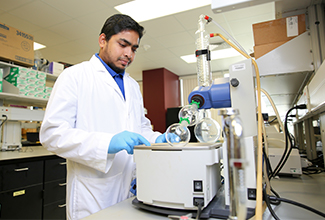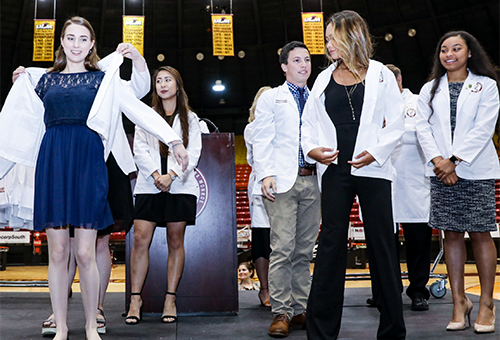

The College of Pharmacy at ULM is Louisiana’s only publicly supported comprehensive center for pharmaceutical education, research, and service. The college includes several modern specialized instructional and health service facilities and numerous affiliated off-campus teaching hospitals and pharmacies throughout the state. The College of Pharmacy offers the following degrees: Bachelor of Science in Toxicology or Pharmaceutical Sciences, Doctor of Pharmacy (Pharm.D.) and Doctor of Philosophy in Pharmacy (Ph.D.)
Are you interested in becoming a part of the ULM College of Pharmacy?
The ULM College of Pharmacy is the only public pharmacy program in the state.
We are home of the first Toxicological Program in the South and remain one of six nationwide.
Our students have the option of earning a Master’s in Business Administration while earning a Doctor of Pharmacy degree.
• The ULM College of Pharmacy’s main campus is housed in a secure facility where only designated individuals can enter.
• Caring and approachable faculty and staff.
• Students have 24-hour building access, providing safe and quiet study areas.
• State-of-the-art labs and mock pharmacy
• Team-based learning with inter-professional activities that allow students to work as a team with other healthcare disciplines
• Unique electives and educational experiences:
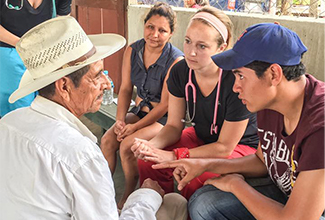
– Medical mission trip to provide medical care in under-served countries such as Honduras and the Dominican Republic
– Veterinary Pharmacotherapy taught through one of the largest veterinary hospitals in northeast Louisiana
– Each year a group of students are selected to attend the weeklong APhA Institute on Substance Use Disorders in Utah
– Skills and knowledge are further enhanced through a wide variety of practice experience opportunities during the last two years of the Pharm.D. program
• Annual career fairs
• Interview training and residency preparatory opportunities
• Networking activities held throughout the year
Clinic Pharmacy Practice
In many clinics that serve diverse segments of the US population, pharmacists are integral members of the health care team whose contributions have been shown to optimize patient outcomes while being cost effective.
Community Pharmacy
Community pharmacists are often on the first line of health care. In addition to dispensing medications and monitoring patients for adverse effects and interacting drugs, pharmacists provide important counseling services, such as the proper selection of over-the counter medications and/or referral to other health care providers.
Geriatric Pharmacy
By 2020, some 37 percent of the U.S. population will be mature adults who will likely consume more than half of all health care resources.
Governmental Agencies
Local, state and federal governmental agencies such as the National Institutes of Health, the Food and Drug Administration, the Veterans Administration and the Armed Forces require the expertise of skilled pharmacists.
Home Health Care
Patients formerly treated in a hospital setting are now receiving professional care in their residences through home health care.
Hospital Pharmacy
Many graduates pursue careers in hospital pharmacy where they are directly involved in patient care.
Managed Care
Broadly stated, managed care is planned, comprehensive and integrated provision of health care in a cost-effective manner that emphasizes preventive care.
Pharmacy
The University of Louisiana at Monroe College of Pharmacy offers a four-year Doctor of Pharmacy (PharmD) degree. To be eligible to apply to our program, applicants must complete approximately two to three years of undergraduate pre-pharmacy courses (a
minimum of 67 semester credit hours), which can be taken at any accredited college or university. Upon admission to the professional program, students begin three years of classroom, laboratory, and practice instruction at ULM, followed by one year of experiential rotations at locations around the state in which students train in a variety of practice settings.
Toxicology
Toxicology is the study of harmful effects of chemicals on people, animals and other living organisms. Most of the good life we have is because we use chemicals properly, including medicines, pesticides and cleaning products. Misunderstanding what
chemicals can do sometimes leads to over-exposure and poisoning or, conversely, unnecessary anxiety and fear of chemicals that are relatively harmless when used properly. Toxicologists are the scientists who help decide how much is too much of a good thing. The School of Basic Pharmaceutical and Toxicological Sciences toxicology program was the first of its kind in the South and is currently one of only six nationally.
Ph.D.
The Doctor of Philosophy degree in Pharmacy is awarded by the Graduate School through the School of Pharmacy. Students must select a major specialization from among the areas of Medicinal Chemistry, Pharmaceutics, Pharmacology, and Toxicology.
Graduate studies in medicinal chemistry involve applying the knowledge of chemistry to research associated with therapeutically useful compounds. This research includes the design and synthesis of new classes of therapeutic agents, the chemical modifications of existing drugs leading to an improved therapeutic effect, the correlation of the chemical structure of a drug with its pharmacological activity, the development and improvement of techniques used in the analysis of therapeutic agents, and the study of how chemical properties affect drug distribution and metabolism
Medicinal Chemistry Required Courses
Research in pharmaceutics involves all aspects of design, development, and evaluation of effective dosage forms/delivery systems, and entails one or more interdisciplinary areas that include physical pharmacy, pharmaceutical analysis, drug delivery, biopharmaceutics, and pharmacokinetics.
Pharmaceutics Required Courses
Pharmacology is the study of the effects of chemicals on living systems and may include the study of individual molecules and cells, tissues or whole organisms. The _eld of pharmacology occupies a central position in the continuum of biomedical sciences such that there are often unclear boundaries between pharmacology and, for example, the _elds of toxicology, biochemistry, physiology, pathology and microbiology.
Dual Degree Pharm.D. / MBA
Because of a growing need for pharmacy profession leaders to be proficient in both the practice of pharmacy and knowledgeable in the business of pharmacy, the ULM College of Pharmacy and the ULM College of Business and Social Sciences offer a dual degree program for the professional pharmacy student to graduate with both the Doctor of Pharmacy (PharmD) degree and the Master of Business Administration (MBA) degree. In addition to completing the curriculum of the PharmD program, the dual degree student will also complete the curriculum of the Pharmacy concentration of the MBA degree.
At the College of Pharmacy, your education extends beyond the classroom.
College advisers can help you choose from a range of opportunities that complement your coursework and put your pharmaceutical knowledge into practice.
Pharmacy Council
Pharmacy Alumni Liaisons (PALs)
American Pharmacists Association - Academy of Student Pharmacists (APhA-ASP)
Christian Pharmacists Fellowship International (CPFI)
Kappa Epsilon (KE)
Louisiana Society of Health-System Pharmacists (LSHP)
National Community Pharmacists Assc. (NCPA)/Louisiana Independent Pharmacies Assc. (LIPA)
Phi Delta Chi
Phi Lambda Sigma (PLS)
Rho Chi
Student National Pharmaceutical Association (SNPhA)
Toxicology
Research, Water: pharmaceutical and chemical companies, Academics, Government, Hospitals, Forensic labs, Consulting
Pharm.D.
Clinical: community or hospital pharmacy practice, Nuclear Pharmacy, Drug Development, Government, Compounding, Academics, Managed Care, Legal Consulting
Ph.D.
Analytical chemist, Biomedical scientist, Clinical research associate, Healthcare scientist, clinical biochemistry, Healthcare scientist, immunology, Medicinal chemist, Pharmacologist, Research scientist
Undergraduate Enrollment (Tuition & Fees)
Full Time per Semester $XXX
Graduate Enrollment- PhD, Pharm D (Tuition & Fees)
Full Time per Semester $XXX
The University of Louisiana Monroe
700 University Avenue
Monroe, LA 71209
318.342.1000