

The University of Louisiana System Board of Supervisors joins with the faculty, staff,
students and alumni of University of Louisiana Monroe to request the honor of your
presence at the Presidential Investiture ofCarrie L. Castille, Ph. D.10th President of the University of Louisiana Monroe |
|
|

INVESTITURE
THURSDAY, APRIL 23, 2026 | 3:00 P.M.
FANT-EWING COLISEUM
|
|
PRESIDENTIAL GALA
THURSDAY, APRIL 23, 2026 | 7:00 P.M.
BAYOU POINTE EVENT CENTER
We look forward to celebrating this historic occasion with you.

President's Biography
Carrie L. Castille, Ph.D.
10th President of the University of Louisiana Monroe
|
|
| Dr. Carrie L. Castille began her role on June 9, 2025, as the 10th president of the
University of Louisiana Monroe. With over a decade of experience in higher education
and nearly 30 years of distinguished public service, she is recognized for her leadership
in science, education, and public policy. Her career has been defined by advancing research innovation, expanding access
to transformative learning, and fostering public engagement that strengthens communities. Dr. Castille previously held national and institutional leadership roles focused on agricultural education and scientific advancement. She was appointed director of the National Institute of Food and Agriculture (NIFA), becoming the first woman to lead the federal science agency within the U.S. Department of Agriculture. Under her direction, NIFA invested over $2 billion annually to support research, education, and extension across the country—prioritizing sustainable agriculture, food system innovation, conservation, and workforce development. She also served as Senior Vice-Chancellor and Senior Vice-President at the University of Tennessee Institute of Agriculture, where she further expanded research capacity, fostered strategic partnerships, and advanced student success as part of her broader mission to serve land-grant institutions and their communities. Between 2009 and 2025, Dr. Castille provided expert support to four U.S. Presidents and received three presidential appointments, reflecting her trusted leadership across multiple administrations and her integral role in shaping national agricultural and rural policy. Her academic career began at Louisiana State University as a faculty member and cooperative extension leader. She later held state government leadership positions, including associate commissioner and science advisor at the Louisiana Department of Agriculture and Forestry, and USDA Rural Development state director for Louisiana—where she oversaw a historic increase in rural investments from $800 million to nearly $1.5 billion. A trailblazer throughout her career, Dr. Castille has been the first woman to hold several influential leadership roles: she was the first female director of NIFA, the first female inductee into the University of Louisiana Lafayette College of Engineering Hall of Distinction (2017), and now serves as the first female president of the University of Louisiana Monroe. She is also a two-time recipient of the USDA Secretary’s Award for Excellence (2003 and 2018), recognizing her enduring contributions to rural America. She serves on multiple boards, including the St. Francis Medical Center Foundation Board of Directors and the Edward Via College of Osteopathic Medicine-Louisiana Advisory Board. Dr. Castille holds a Ph.D. in Renewable Natural Resources (with an emphasis on environmental and public policy) and an M.S. in Environmental Studies from Louisiana State University, along with a B.S. in Industrial Engineering from the University of Louisiana at Lafayette. She is married to Dr. Robert Robichaux, and they have two children, Josh and Megan. Dr. Castille and Dr. Robichaux welcomed with joy their first grandbaby, Bennett Andre Spansel, on July 19, 2025. |
Tradition Of The Investiture
|
|
What Is An Investiture?
| The University of Louisiana Monroe’s Investiture Ceremony is a distinguished academic tradition that formally honors the installation of the university’s president. Rooted in centuries-old academic custom, the investiture marks the official conferral of authority and leadership through ceremonial regalia and symbolic elements such as the presidential medallion and mace. The event brings together faculty, staff, students, alumni, and community leaders to celebrate continuity, institutional achievement, and the beginning of a new chapter in ULM’s history. Past investitures have featured academic processions, remarks from university and system leaders, and festive activities that reflect ULM’s commitment to excellence and service. |
Presidential Chain of Office
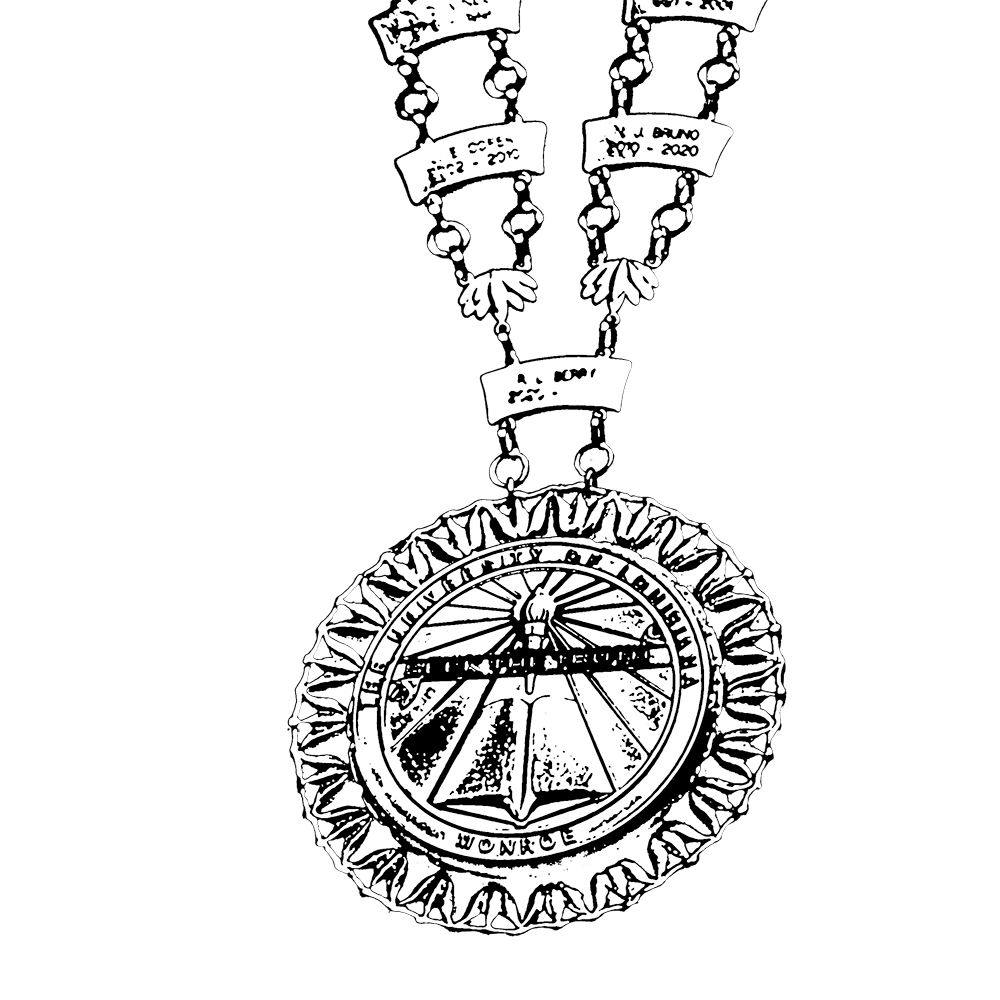 |
| The specially-designed Presidential Chain of Office is an intricately-detailed sculptural interpretation of the University seal which is surrounded by a decorative bezel. The seal is attached to an elegant chain with engraved banners which bear the names of former chief executive officers and presidents of the campus. Engraved metal plates displaying the letters ULM are found above the banners on each side of the chain. This chain represents the history and tradition of the University and establishes an enduring legacy for the institution. |
University Mace
 |
| The University Mace is a time-honored symbol that represents the light that knowledge brings to humankind. Across the centuries, it has been recognized by scholars throughout the world as an emblem of education and enlightenment. The mace stands to the left of the podium and is present at all ceremonial occasions which celebrate academic excellence at the University. It not only represents the academic mission but also serves as a repository of the history of the institution, listing every name that the University has been officially designated during its evolution. |
University of Louisiana Monroe Historic Overview
 |
| The history of the University of Louisiana Monroe is a record of educational leadership
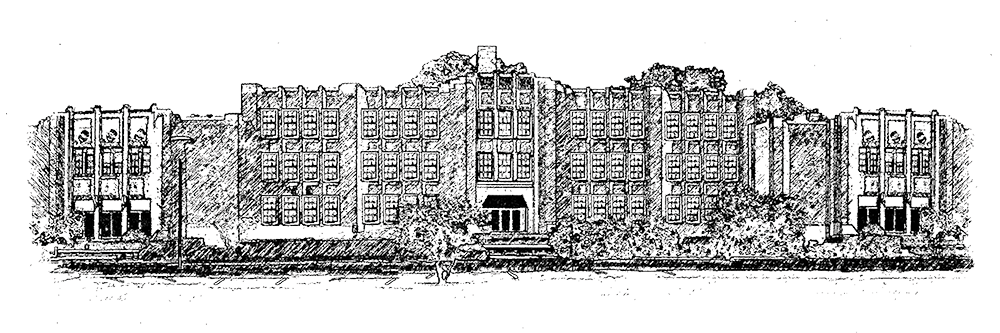
and progress with time. In 1922, Timothy Oscar Brown, superintendent of Ouachita Parish Schools perceived the need for an institution that would provide college training for the great number of local high school graduates. After a thorough study of the situation, Brown presented the idea in an address to the Monroe Kiwanis Club, where it was favorably received. The challenge was that additional legislation would be necessary to provide a satisfactory method for the establishment and maintenance of a junior college. Accordingly, a bill was introduced in the regular session of the Louisiana State Legislature in May 1928, and was subsequently enacted into a law providing for the establishment of junior colleges. Included in Act 173 was the right of a school board to call an election to vote a parish-wide tax for the support of such an institution. Following the adoption of the bill, the Kiwanis Club, cooperating with the Rotary Club, the Lions Club and the Chamber of Commerce, perfected a plan to found a junior college in accordance with the Junior College Law.On November 9, 1928, the Ouachita Parish School board organized a Junior College District and called a special election to vote the special tax of one mill for a period of 10 years for the construction, equipment and operation of the junior college. The Police Jury and the School Board of Ouachita Parish, in joint session on January 4, 1931, purchased the site for the college. The building, including equipment and grounds, represented an investment of over $350,000. The first session of the Ouachita Parish Junior College began on September 28, 1931, with a full corps of teachers and an enrollment of 416 students. At that time, this was one of the only junior colleges in Louisiana. Thus was realized the dream of T.O. Brown – that educational advantages beyond high school graduation should be the possession of the citizens of Ouachita Parish. Ouachita Parish Junior College graduated its first class of 135 students in June 1933. ULM has followed a course of vigorous growth in its transition from a junior college to an institution offering a comprehensive range of undergraduate and graduate degree programs. In September 1931, the university opened for its first session as Ouachita Parish Junior College, which was operated as part of the Ouachita Parish School System. In 1934, Louisiana State University received authority from the State Legislature to operate the facilities of the university as Northeast Center of Louisiana State University. The name of the institution was changed to Northeast Junior College of Louisiana State University in 1939. The following year, the State Legislature authorized the transfer of all lands connected with Northeast Junior College to Louisiana State University. The 1950 Legislature approved the expansion of Northeast Junior College of LSU to a four-year senior college granting academic degrees. The name of the institution was changed to Northeast Louisiana State College, and its control was transferred from the Louisiana State University Board of Supervisors to the State Board of Education. The name was changed to Northeast Louisiana University by the 1970 Legislature. The constitution, adopted by the people of Louisiana in 1974, provided that the administration of state colleges and universities be changed from the Louisiana State Board of Education to the Board of Trustees for State Colleges and Universities effective May 1975. This board’s name was changed again on June 8, 1995, to the University of Louisiana System Board of Supervisors. On August 27, 1999, the university officially changed its name to the University of Louisiana Monroe. |
ACCOMMODATIONS & CAMPUS MAP
The Hotel Monroe
|
|
120 Walnut Street | Monroe, LA 71201
hotelmonroe.com
For reservations, please call 318.460.3966. Please reserve by April 10, 2026 using the reservation code ULM.
Hampton Inn
|
|
601 Mane Street | West Monroe, LA 71292
hilton.com
For reservations, please call 318.938.2800. Please reserve by April 4, 2026 using the reservation code ULM.
| INVESTITURE Fant-Ewing Coliseum 4201 Bon Aire Drive, Monroe, LA 71023 |
PRESIDENTIAL GALA Bayou Pointe 1 Warhawk Way, Monroe, LA 71203 |
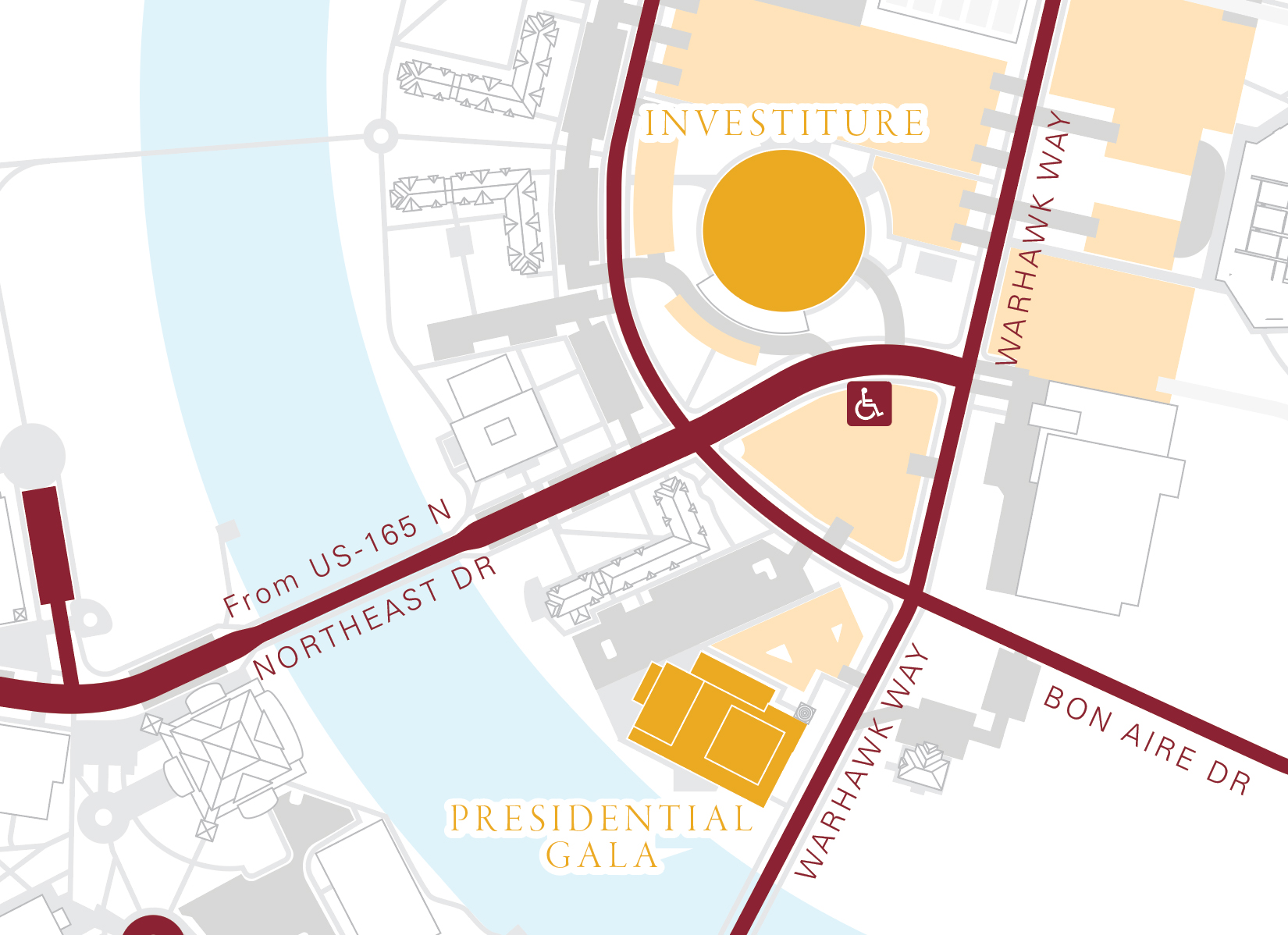
Complementary parking is available and marked in beige on the enclosed map.
Persons with a disability who need assistance should call Shane Dykes at 318.342.5177 to make arrangements prior to April 23, 2026.For more information, e-mail investiture@ulm.edu or call 318.342.5429