

The Hawkeye - Student Newspaper
Administrative/Academic Contacts
Office of Marketing & Communications


Contact:
Office of Marketing
and Communications
LIB Suite 205
318-342-5440
omc@ulm.edu
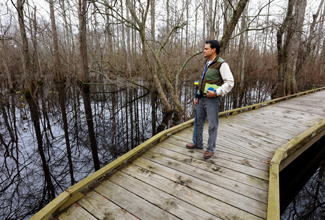
Monroe, La. — Unlike many researchers, Dr. Joydeep Bhattacharjee does not carry out his research within the confines of an office, library, or on-campus laboratory.
Bhattacharjee, associate professor of Biology, spends most of his time wading through flooded bottomland hardwood forests, scouring fallow fields, and at times slogging through coastal marshlands.

His research centers on plant and restoration ecology, a field which aims to assist in the recreation and recovery of an ecosystem that has been degraded, damaged, or destroyed. One of Bhattacharjee’s main areas of expertise is monitoring the exchange of gases such as carbon dioxide (CO2) and water vapor between the atmosphere and vegetation. Such studies have become crucial in understanding the driving forces behind climate change.
“It’s beyond all doubt that the climate is changing,” Bhattacharjee expressed. “Both the scientific community and the general populace now understand that the climate is indeed changing. The challenge now is determining what can be done to reduce the effects. Perhaps we should now focus more on the importance of plants since they have been absorbing CO2 for millions of years.”
According to the U.S. Environmental Protection Agency (EPA), “Since the Industrial Revolution began around 1750, human activities have contributed substantially to climate change by adding CO2 and other heat-trapping gases to the atmosphere.” Between 1990 and 2013, CO2 emissions in the U.S. were shown to have increased by about 7%. Research has demonstrated that CO2 and other greenhouse emissions must be reduced in order to mitigate climate change.
But before regulatory processes can be implemented and precise climate change forecasts made, gas exchanges must be well quantified and understood. And this is precisely where Bhattacharjee’s research into the dynamics of carbon dioxide exchange in Bottomland Hardwood Forests comes into play.
“During the course of my research, I realized that no one was really talking about the importance of bottomland hardwood forests in global carbon research. But these forests are critical—we have lost about 70% of these forests in our region. These deciduous forests are like large sponges absorbing substantial amounts of the CO2 from the atmosphere during the leaf-on periods. My goal has been to study flux dynamics of these gases in an attempt to identify a pattern.”
Bhattacharjee’s main tool for collecting data is a 120-foot tower outfitted with multiple sensors that continuously monitor carbon fluxes.
Located in the heart of Russell Sage Wildlife Management Area (WMA), only a short drive from ULM’s campus, this tower—known as the “ULM Flux Tower”—is the only such tower in the entire state. Bhattacharjee indicated that he had some initial concerns about how local hunters would respond to the presence of the tower. In other states, sensors on towers have been shot at, costing researchers many thousands of dollars in damage repair. But, according to Bhattacharjee, nothing like that has happened on Russell Sage.
“One of the funniest things I’ve heard is that hunters come up to the tower wondering, 'What is that giant deer stand thing?,' said Bhattacharjee.
The biggest challenge Bhattacharjee faces is manpower. While most projects of this kind involve many researchers working together to collect and interpret data, Bhattacharjee is a one-man team. However, he does have several dedicated students working directly with him on his research. One of his undergraduate students (Mr. Shiddhartha Dhakal) presented some of his own findings at a regional conference at the University of Georgia, Athens, for which he also received an award.
Bhattacharjee’s next goal is to obtain a grant for a methane sensor, something that is lacking from the ULM tower. “Methane monitoring is critical because it is about four times more potent in trapping heat than CO2. During waterlogged conditions Russell Sage does emit some methane due to the decomposition of leaves and my hand just itches because I can’t measure it. Methane sensors cost about $40,000, but one of them is on my wish list.”
In addition to his passion for research, Bhattacharjee is equally passionate about teaching. Some would say he was predestined to be a teacher; “acharjee” is an Indian name meaning “teacher.” It is therefore no surprise that he is a favorite among students around campus. He has been the recipient of several teaching awards just in the last few years, including the Award for Excellence in Research in the College of Arts Education and Sciences; the ULM Foundation Award for Excellence in Teaching in 2015; and the Accent on Excellence Teacher of the Year Award in 2015.
In 2015, Bhattacharjee was named the first Administrative Fellow for Academic Affairs, a position designed for two main purposes: to 1) assist the Vice President for Academic Affairs in completing the work needed to operate the Office of the Vice President for Academic Affairs and 2) provide experience to full-time, tenured faculty members who are interested in pursuing an administrative position in the future.
“Dr. Bhattacharjee did an outstanding job as our first Administrative Fellow,” said Dr. Eric Pani, Vice President for Academic Affairs. “Two characteristics that stood out during the interview process used to fill the position were Dr. Bhattacharjee’s enthusiasm and his ‘can do’ attitude. It turns out that he displays these same mannerisms in his teaching and research too. He was clearly named ‘Joydeep’ for a reason—his joy runs deep in his persona.”
Bhattacharjee reflected on the rare privilege of serving as the university’s first ever Administrative Fellow for Academic Affairs. “Foremost, I had a great experience working with Dr. Pani. He made me feel very comfortable and provided me with opportunities that otherwise would have been impossible to experience."
“To mention one, I was able to attend the Board meeting of the UL system Presidents and Vice-Presidents. I felt honored to have shaken hands with most of the Presidents and Vice presidents of the UL system in one day. I was able to get an insider’s view of how policies are discussed and decisions made at the higher levels of administration, which most faculty members do not get to experience.”
Bhattacharjee earned a Ph.D. from Texas Tech University and has published widely in the area of plant ecology.
