
University of Louisiana at Monroe

Department of Communication

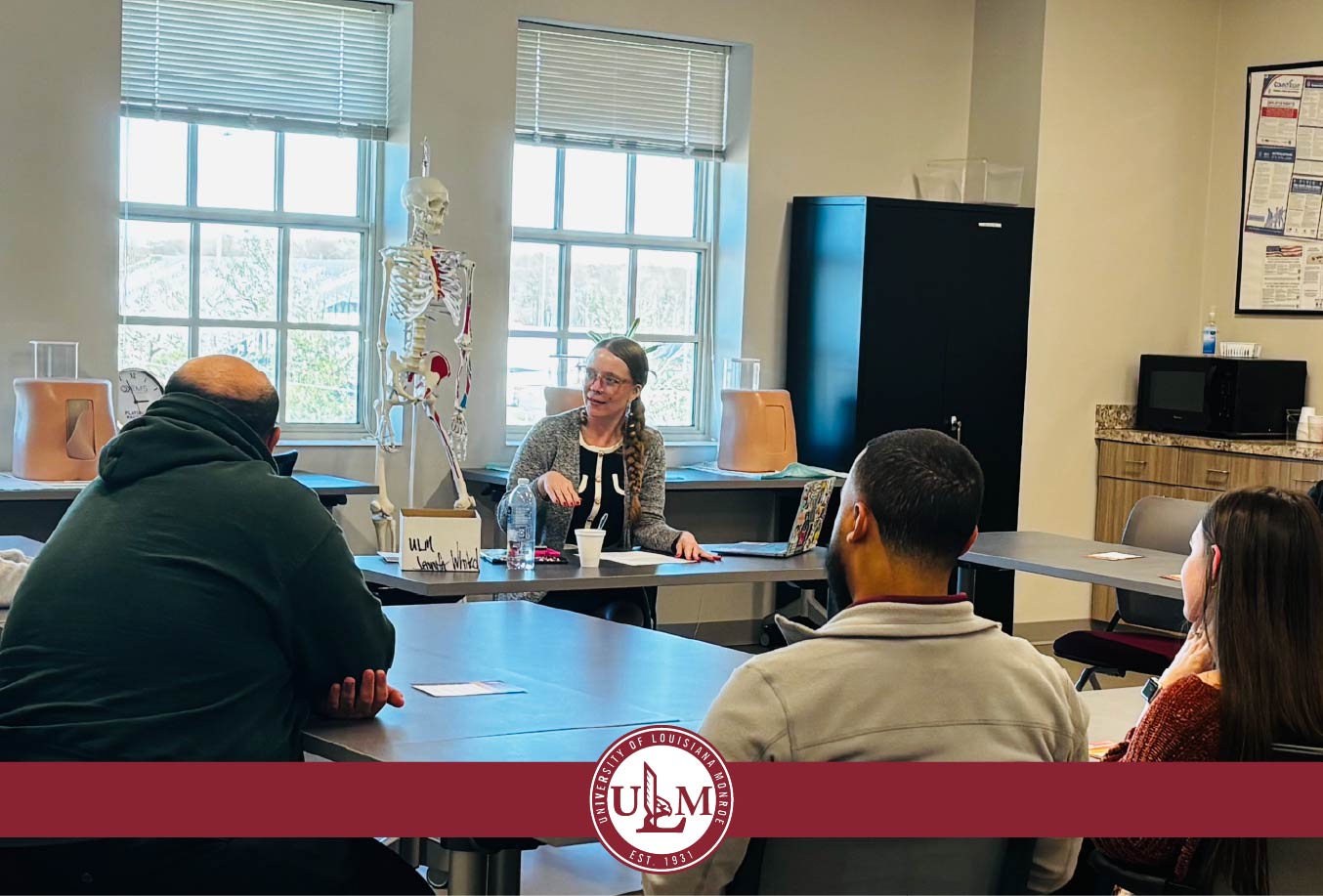
Classroom lecture

The Master of Arts in Communication is designed to improve professional competency through advanced study and scholarly research and to prepare students for further study.

Master of Arts in Communication

Why Study Communication?

Because we live in an increasingly specialized, as well as fragmented society, it becomes more and more necessary to develop areas of expertise, to learn and use well developed critical thinking skills, and to apply advanced communication concepts, research, and theories to a wide variety of purposes. Business, government and service organizations consistently seek professionals with advanced written and oral communication skills. They also demand professionals who have developed proficiency in communication management and the use of new technologies that are driving global economic expansion.

Why Study Communication at ULM?

We are the only Master’s program in Communication in Northern Louisiana, and the only Master of Arts in Communication in the University of Louisiana System. Our interdisciplinary approach to the study of Communication offers unique opportunities to individuals who are interested in excelling in the corporate world, or who intend to earn a Doctorate in Communication. Our program offers one on one attention, and an individualized degree plan that is tailored to your specific needs.

Earning your Master’s degree in Communication at the University of Louisiana, Monroe gives you the opportunity to achieve these things and much more. Not only will you grow in specific skill sets, you will have the opportunity to grow as an individual, increase your confidence, and know you are capable of accomplishing great things.

Program Overview:

The Department of Communication at the University of Louisiana at Monroe offers an interdisciplinary M.A. degree in Communication.  This means students complete 36 graduate course hours from among the courses offered in both Communication Studies and Mass Communication. A cooperatively designed plan of study with professors in the department allows students to tailor the degree to individual needs. This may include completing courses in cognate areas such as Political Science, Sociology, English, Business, etc.

Our graduate level courses integrate theory, research and practical applications from the communication discipline to increase both breadth and depth of understanding. As such, all students take a common nine semester hours, learn both quantitative and qualitative research methodologies, and must choose between a thesis or exit project. Students electing the thesis track select 30 semester hours of coursework within the area of communication and related fields, plus six hours of thesis credit. Students electing the non-thesis track select 33 semester hours of coursework, plus three hours of exit-project credit.

Faculty:

Our learning community consists of a diverse group of scholar-educators/scholar-artists. Faculty strengths lie in three broad based areas:

1) Interpersonal and organizational communication, which includes areas such as conflict management, language, nonverbal communication,  communication and cultures, health communication, communication in families and personal relationships, communication and gender;

2) Strategic communication, which includes such areas as political communication, performance studies, persuasion, rhetoric and rhetorical criticism, and public relations, visual communication; public opinion and propaganda; and

3) Journalism and Media Production, which includes areas such as communication law, regulation and ethics,  reporting, electronic news gathering; audio, video, and film production, analysis and criticism.

Applying to the Program:

All students must submit an application for admission, GRE scores and undergraduate transcripts to the Office of Graduate Studies and Research. Guidelines and applications for admission are available on the Graduate Studies and Research web page http://www.ulm.edu/gradschool/admis.htm.

In addition, the Department of Communication requires a 200-400 word statement describing the applicant’s academic and professional goals. This statement should address reasons for pursuing a master's degree in Communication, anticipated career path and desired outcomes, and major areas of interest in the Communication discipline.

To receive full consideration for Fall admission, all application materials must be received by the Graduate Coordinator for the Department of Communication by March 15th. For Spring admission, all application materials must be received by the Graduate Program Coordinator for the Department of Communication by October 15.

Entering students must meet at least one of the following criteria:

1. a minimum cumulative undergraduate grade-point average of 2.5,

2. a minimum combined Qualitative and Verbal scores of 900 on the GRE General Test, or

3. a combined score of 1875, determined by multiplying the total undergraduate grade-point average by the combined GRE Qualitative and Verbal scores.

Applicants who fail to meet the above standards may be admitted on conditional status as recommended by the Graduate Admission and Retention Committee of the Department of Communication in concert with the Director of Graduate Studies and Research.

Graduate Assistantships and Graduate Work-Study

The Department of Communication offers both Graduate Assistantships and Graduate Work-Study opportunities. Graduate assistantships provide a tuition waiver and a small stipend. Graduate work-study positions offer an out-of-state tuition waiver and a small stipend.

Individuals awarded a graduate assistantship work as research assistants during her/his first year. For the second year, a graduate assistant can request a teaching assignment. Individuals awarded a graduate work-study position will work in the computer lab, the resource room, the equipment room, or with faculty on discipline specific tasks. Because assistantships and work-study positions are competitive it is wise to apply for both.

For application and recommendation forms, go to:

http://www.ulm.edu/gradschool/GradWorkStudy.htm for work-study, or http://www.ulm.edu/gradschool/GradAssist.html for assistantship.

In addition to the application form and letters of recommendation, applicants should include a brief writing sample that demonstrates the applicant’s strengths as a writer.

All GA/GWS application materials should be submitted directly to:

Dr. Peggy Bowers
Graduate Coordinator
Department of Communication
120D Stubbs Hall
University of Louisiana at Monroe
Monroe, LA  71209

If you have additional questions, please contact Dr. Bowers at 318-342-1406 or bowers@ulm.edu